

Kink, Clinic, Clarity: Why the KAPA congress is more than just an event
KAPA stands for Kink Aware Professional Association, an Austrian organization we introduced to you here some time ago. Behind it are experts from various disciplines such as medicine, law, youth work, and psychology, who you can turn to if you are struggling with an issue related to your preference for BDSM but fear being stigmatized because of it. That is exactly what KAPs do not do.
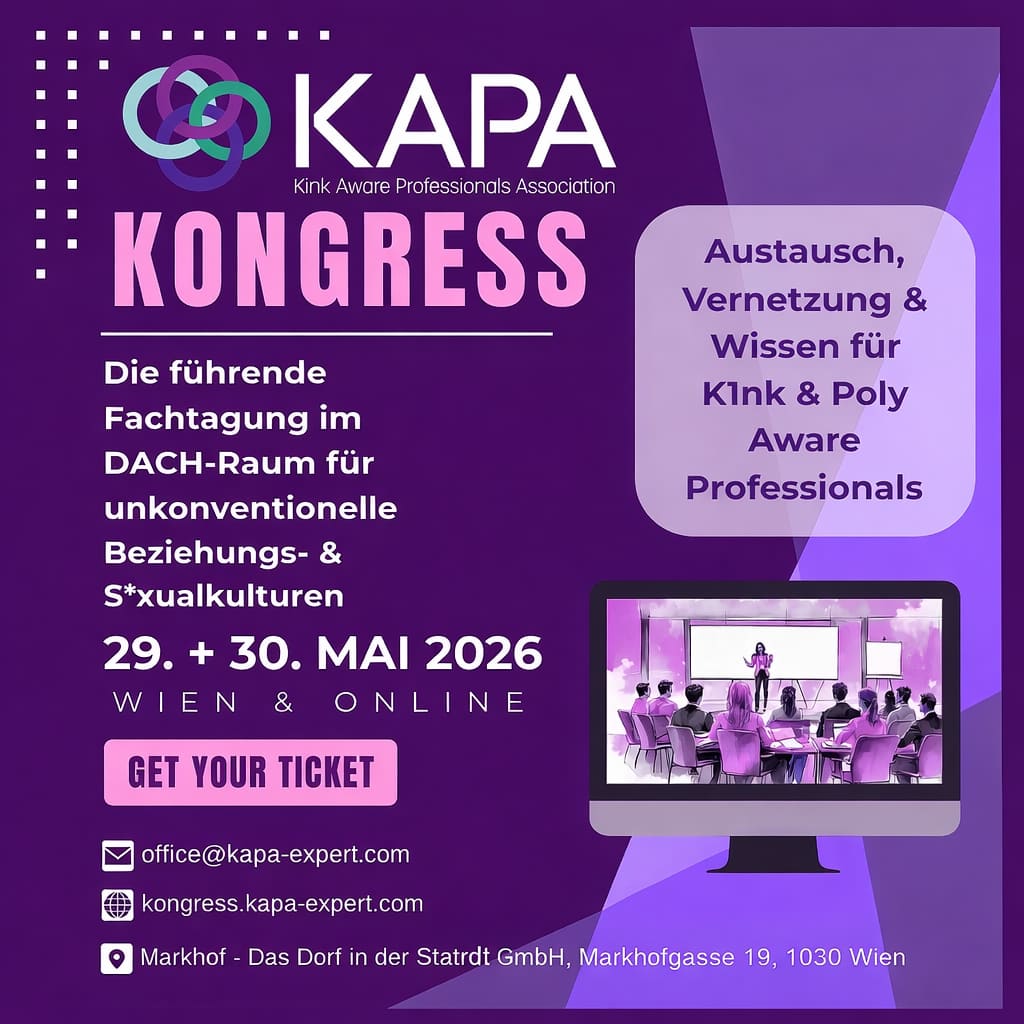
And above all, KAPs are not just a passive list but actively engage in education. Classically via social media and, at the end of May 2026, also with the first congress of its kind in Vienna. For two days, on May 29 and 30, 2026, experts will dive deep at the Markhof venue and online. Topics range from kink shaming in clinical practice and altered states of consciousness to anorectal injuries, kink in pregnancy, parasocial relationships, and the role of artificial intelligence. You can find the full program and tickets here.
But why is all of this actually so important? We asked Vice President Martin Gostentschnig.
Who are you primarily aiming to attract?
Martin: Our goal is to bring together people who see working with alternative relationship models and sexuality as an integral part of modern healthcare and professional counseling, reflecting the diversity of social realities. At the same time, it is important to us to ensure greater competence and quality standards in this field.
How many visitors are expected on site?
Martin: For this intensive format, we are planning around 120 participants on site. It is important to us that the atmosphere allows for real exchange, moving away from anonymous mass events toward a space where interdisciplinary networking can truly take place.
The first talk focuses on heteronormativity and moral value assumptions in clinical practice in hospitals. Very interesting, especially the practical examples. Can you already share something about this?
Martin: This program point is essential because it addresses the “blind spot” of many institutions. In clinical settings, there is often an unconscious assumption of a heteronormative biography. In practice, this leads to barriers, kink shaming, and in the worst case, inadequate care. Dr. Kirchheiner will use practical examples to show what a sensitive approach looks like, one that questions moral assumptions and creates a safer environment for all patients.
More information can also be found on KAPA’s Instagram profile .
Not only professionals such as therapists and doctors are speaking, but also entrepreneurs and artists. How do they fit into KAPA and the congress?
Martin: Because we cannot and do not want to view sexuality in isolation in a laboratory. Entrepreneurs drive innovation, whether through new tools or digital platforms. Artists, on the other hand, have the language to express pain, pleasure, and identity beyond ICD-10 codes. When a sexual medicine specialist, a sex therapist, and an artist come together, synergies emerge that we urgently need for modern healthcare and a contemporary understanding of relationships and sexuality. KAPA deliberately breaks with conventional and restrictive ideas and invites people to look beyond their own perspective.
A topic that is also being addressed and has long been relevant for us at Deviance is the growing role of AI and streaming in the sexual sphere. What is your perspective on this?
Martin: We are observing this development very closely. AI and streaming are no longer fringe phenomena. They shape the formation of sexual scripts and the experience of intimacy for entire generations. At KAPA, we take an observant and professionally grounded stance. We discuss risks such as addictive potential or distorted body images, but also the potential of VR and AI as therapeutic tools or as instruments for sexual self-determination.
Beyond more acceptance and awareness, what is the goal of the congress?
Martin: KAPA is far more than an event. It is the establishment of a new professional culture. In our understanding, the KAPA congress and the KAPA network form an inseparable unit. While the congress creates space for scientific competence, empathy, and interdisciplinary dialogue, the network ensures the transfer of these values into everyday practice and maintains the connection to the community.

We want to end the lack of communication, both between disciplines and in the dialogue between professionals and clients. The congress acts as a catalyst. Participants return to their professional routines with a sharpened perspective and practical tools, enabling them to embody a professional approach that combines expertise with the recognition of human diversity.
Our mission is to establish lasting quality standards in supporting alternative relationship and lifestyle models through this living network. KAPA is the starting point for an informed discourse, for progressive expertise, and for a community that continues to shape the future of professional support beyond the congress itself.
Dr. Martin Gostentschnig is a psychotherapist, clinical psychologist, philosopher, and, not least, simply a human being. As KAPA’s vice president, he also engages in educational work on social media under the name @dr.k1nkaware and specializes in BDSM and alternative sexualities as a psychotherapist.